Keep the member. Recover the balance. Before charge-off.
Debt Digest is the software credit unions use to give past-due members a fair, self-service way to catch up online, on your brand, on your timeline. Built around the NCUA 120-day charge-off window. Your team presses send on the outreach you place. Flat per-account subscription: no contingency, no percentage of recovery.
See how the compliance works · your team presses send on the outreach you place.
Credit unions today. The broader creditor industry over time.
People can enroll before you join. Their analysis comes with them.
Members can enroll and analyze their accounts before your credit union joins the rails. When you join, anyone who flagged you appears in your inbox, and you connect each one by placing your own record. Counts only: this page does not name any consumer. $2.50 per active account per month. Never a percentage of recovery. Consumers are not charged that fee.
- People can enroll before you join.
- Their account analysis comes with them.
- $2.50 per active account per month, never a percentage of recovery.
Ways your members catch up
Two ways your members catch up · one platform · your brand throughout
Catch up before charge-off
Reach members while there is still time
Give past-due members a self-service way to get current before the account is written off, on the timeline your portfolio runs on. Your team presses send on the outreach you place. How the timing works.
Settle online, without phone tag
A clear path to a settlement you approve
When a member or their representative wants to settle, they do it in one online place: offers, counters, and e-sign, all on the screen, with payment confirmation once your payment rail is connected at pilot setup. Every offer is checked against the floor you set, so nothing goes below your number.
Firm-negotiated accounts
For post-charge-off accounts with legal representation
When a member retains a settlement firm, your team works the account through the settlement workspace. Firm submits an offer; your configured floor auto-approves or routes it for review. E-sign and remittance in the same thread.
Live today, and growing as credit unions pull us forward.
You decide when members hear from you.
The outreach you place goes out when your team presses send. The platform prepares each one in your name, and the send is appended to the hash-chained audit log. Flat per-account subscription: no contingency, no percentage of recovery.
-
1
Import your accounts
Export from your core (Symitar, CU*BASE, or equivalent). We build a per-account profile and mark each account as Not Yet Contacted.
-
2
Review who hasn't been contacted
Filter to the Not Yet Contacted queue. See the channel recommendation, which your operator can override, before your team sends. The onboarding wizard is where your team reads the notice itself. Where the consumer’s state is on file, texts outside that consumer’s local quiet-hours window are blocked; where it is not, an Eastern-time window applies. Every step is auditable.
-
3
Click to send: you're in control
One button. Your outreach goes out under your credit union's name, your reply-to, your brand. The hash-chained audit log captures the sending organization, the time and the batch.
Creditor-initiated
How the three paths actually compare.
Most creditors pick one of three delinquency strategies. Here's what each costs, and what you give up.
| Attribute | Traditional agency | In-house collections | Debt Digest |
|---|---|---|---|
| Pre-charge-off intervention | No | Partial | Yes, 45–115 DPD |
| Typical cure / recovery rate | 10–18% | 15–20% | Measured against your baseline |
| Member relationship preserved | Often broken | Varies by agent | Preserved, self-service |
Your legal team wrote our spec, not the reverse.
Quiet hours, dispute holds, and frequency counters run in the send path where this page names them. Representation checks fail closed on collector and firm send paths; the creditor path skips that check when identity is incomplete. Legal duties still follow each identified participant's actual role and conduct.

FDCPA §1692eFDCPA §809(a) Validation notice
FDCPA §809(b) Dispute pause
Reg F §1006.6 Outreach windows
Reg F §1006.34 Itemization
NCUA 12 CFR 741.3 120-DPD rule (credit unions)
FFIEC URCC 180/120-DPD rule (banks)
TCPA 47 U.S.C. §227 Quiet hours
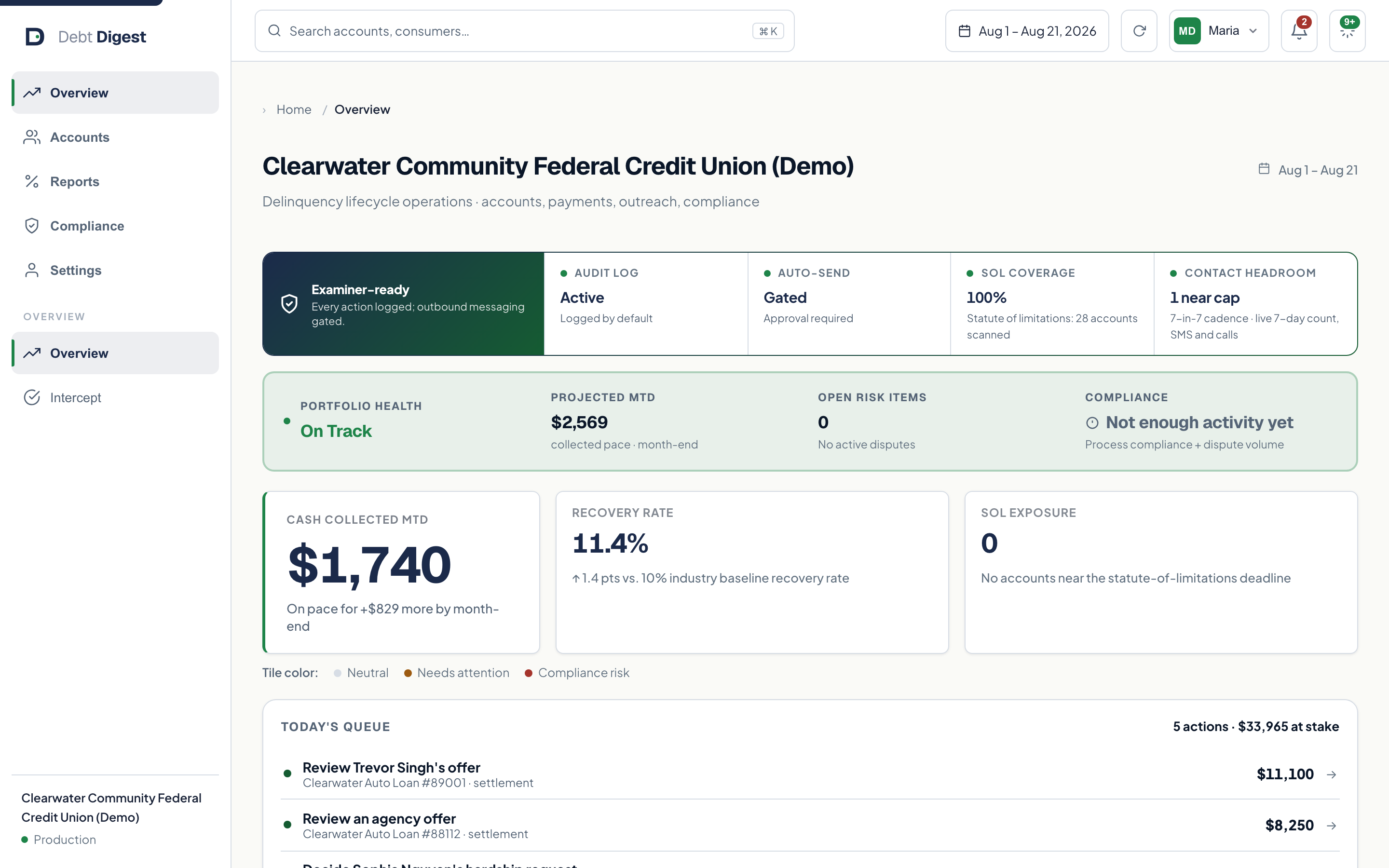
See Debt Digest in action.
The three surfaces your portfolio team will actually use during the pilot.
| Member | Balance | DPD | Status | Outreach |
|---|---|---|---|---|
| J. Martinez | $4,200 | 67 | Delinquent | Plan accepted |
| S. Chen | $12,900 | 104 | 91–115 | Pending |
| M. Williams | $8,400 | 51 | Delinquent | Plan viewed |
| A. Patel | $2,650 | 0 | Cured | 60-day current |
| Member | Balance | Offer | Discount | Status | Days left |
|---|---|---|---|---|---|
| James T. | $4,200 | $2,940 | 30% | Pending | 14 days |
| Sarah M. | $8,900 | $5,340 | 40% | Accepted | n/a |
| David K. | $15,400 | $9,240 | 40% | Declined | n/a |
| Ana P. | $2,800 | $1,960 | 30% | Accepted | n/a |
Ready to see your portfolio here?
Request a pilotSix surfaces. One workspace. Built for the regulator over your shoulder.

Start on the dual-trigger free tier. Keep going only if the measured baseline holds.
Non-exclusive. Champion-challenger structure. No upfront platform fee. All accounts returned to you on exit, with no lock-in.
Binding pilot agreement. Covers your baseline, pricing, and the dual-trigger free-tier exit. Your counsel reviews in one session.
One CSV from your core (Symitar, CU*BASE, or equivalent). We create member records and seed outreach profiles per account.
Members self-resolve in the portal. Weekly status reports. Cure rate vs your baseline updates live in your dashboard.
The evaluation is free until you place 100 accounts or 30 days pass, whichever comes first, and does not convert automatically. Continued paid access begins only after a separately accepted subscription order form. Standard pricing is $2.50 per active account per month with a $1,500 monthly floor; there is no per-resolution, outcome, contingency, or percentage-of-recovery fee.
At what cure rate does Debt Digest pay for itself? Almost any.
Four numbers from your last 12 months. See how the platform subscription compares against the incremental recovery your team (or a 25–40% contingency agency) would have left on the table anyway.
Replace the seed with your own 12-month history on the same DPD bucket, or the default in your order form. We report recovery lift against that baseline; it is an ROI-reporting benchmark, never a fee trigger. Cure definition: 0 DPD + 60 days current.
Illustrative. The evaluation is $0 until 100 accounts or 30 days, whichever comes first, and does not convert automatically. A separately accepted standard order form is $2.50 per active account per month with a $1,500 monthly floor. No per-resolution or percentage-of-recovery fee.
Subscription pricing that scales with your portfolio, not your recovery.
No per-seat fees. No setup charges. No percentage of recovery. Flat per-account subscription billed monthly.
- Guided onboarding on your brand
- Recovery lift reported against your own baseline
- CSV placement, member portal
- Real-time dashboard + audit export
- Founder-led weekly review
- Everything in Pilot
- Outreach intelligence + operator override
- Post-charge-off recovery available
- Online settlements with outside firms
- API access + webhooks
- Everything in Standard
- Branded entry domain on your own subdomain
- FIS / SS&C / Jack Henry core integration
- Dedicated compliance + success operator
- State expansion handled by DD
Cure definition: account returns to 0 DPD and remains current 60+ days. This is how your recovery ROI is reported, not a billing trigger. Your baseline (your own 12-month history, or the default in your order form) is a reporting benchmark, never a fee basis. Payment flow: member pays you directly. You pay Debt Digest a flat monthly subscription. No percentage of recovery. Detailed terms on /pricing.
Plain answers to the four questions every procurement deck includes.
No spin. If a question doesn't have a clean answer yet, we say so.
Built by someone who has been in the courtroom.
Debt Digest's founder works at a debt-settlement law firm representing people being sued for credit-card debt. Every day, hundreds of clients walk in scared, confused, and convinced they are the only one who is behind. Almost all of them want to pay. They just do not know how, and every collections call they have had made it worse.
The usual model is built around post-charge-off agencies who get paid to pressure. Debt Digest moves the moment of help earlier, takes the pressure out of it, and gives members a path they can actually take. Your members are your owners; the experience should reflect that.
This is not a collections company trying to sound nice. It is the product we wish existed for every client we have represented.
See the math on your portfolio in 30 minutes.
Send us the size of your 45 to 115 DPD population. We'll model your cure-rate lift, pilot economics, and pilot rollout plan at no cost, no obligation.
Your accounts. Your settlement floor. Your member relationship.
We're the rails. You stay the holder of the debt, the brand on the screen, and the destination of every dollar.